
DA vs CDC: Which Approval Path Is Right for Your Project?
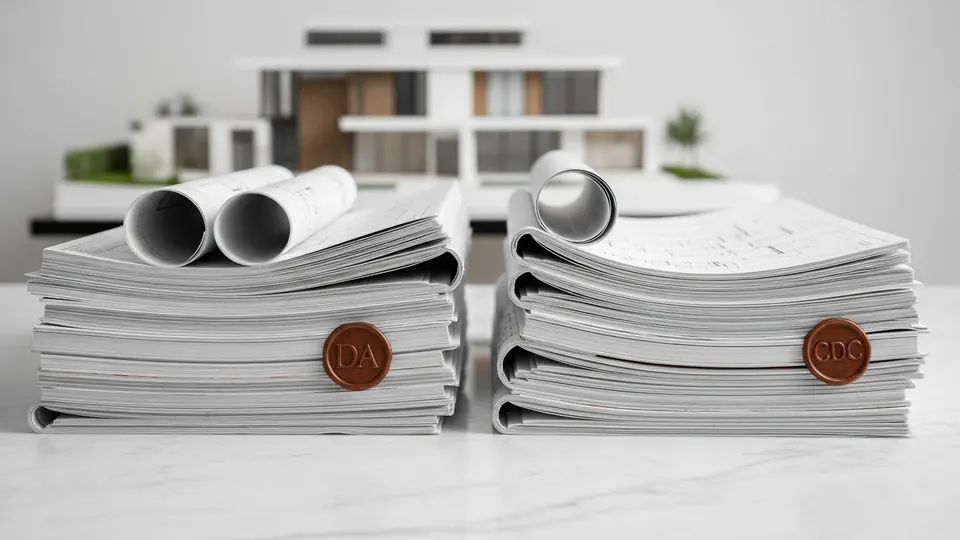
Building approvals can feel complicated at first. The two most common pathways for residential projects are the Development Application (DA) and the Complying Development Certificate (CDC). While both result in permission to build, they are fundamentally different processes with distinct timelines, costs, and levels of flexibility. Choosing the right one shapes your timeline, your costs and your design. This guide explains the difference between a DA and a CDC in plain language to help you understand which path might be right for your new home, extension, or granny flat.
What is a Development Application (DA)?
A Development Application (DA) is the traditional and most common method for getting approval to build. It involves submitting a detailed application to your local council for assessment. The council will review your proposed development against its Local Environmental Plan (LEP) and Development Control Plan (DCP). These documents contain specific rules about what can be built in your area, covering everything from building height and setbacks to materials and environmental impact.
The DA process is designed for projects that require a merit-based assessment. This means that even if your project doesn't perfectly align with every single rule in the DCP, the council can use its discretion to approve it if they believe it has merit and won't negatively impact the neighbourhood or environment. This flexibility is the DA's greatest strength, making it suitable for unique sites, complex designs, or projects in sensitive areas (like heritage conservation zones).
What is a Complying Development Certificate (CDC)?
A Complying Development Certificate (CDC) is a streamlined, fast-track approval pathway that bypasses local council assessment. Instead, a qualified private certifier or council certifier assesses your plans against a set of state-wide planning controls, primarily the State Environmental Planning Policy (Exempt and Complying Development Codes) 2008, often called the "Codes SEPP".
Unlike a DA, the CDC process is not merit-based; it is a "tick-the-box" exercise. If your project meets every single one of the specified development standards—such as maximum height, floor area, setbacks, and landscaping—it can be approved. There is no room for negotiation or variation. This rigid approach is what allows for its speed. A CDC can often be issued in a matter of weeks, whereas a DA can take many months.
Pros and Cons of Each Path
Development Application (DA)
- Pros: Offers flexibility for designs that don't fit strict codes, suitable for unique or constrained sites, allows for community consultation (which can be a pro or con).
- Cons: Can be a slow and lengthy process (3-12 months is not uncommon), may involve neighbour objections and political elements, and the outcome can be less certain.
Complying Development Certificate (CDC)
- Pros: Significantly faster approval time (often 2-6 weeks), provides certainty as the rules are non-negotiable, and is often more cost-effective due to shorter timeframes and fewer consultant reports.
- Cons: Inflexible design criteria (no variations allowed), not available for all properties (e.g., some heritage or bushfire-prone areas are excluded), and requires strict adherence to every rule.
How Good Drafting Supports Either Path
Whether you pursue a DA or a CDC, high-quality drafting is non-negotiable. For a DA, your drafter's job is to present a compelling case to council. The plans must be clear, accurate, and accompanied by a well-written Statement of Environmental Effects that justifies the design and demonstrates how it complies with the spirit of the local planning controls. The quality of the documentation can directly influence how smoothly the assessment process goes.
For a CDC, precision is everything. Your drafter must meticulously design the project to meet every single requirement of the Codes SEPP. A single error or non-compliance, no matter how small, will result in the application being rejected by the certifier. A good drafter understands the nuances of the code and can design a home that maximises your outcomes while meeting every standard in the code, ensuring you can take advantage of this fast-track pathway.